
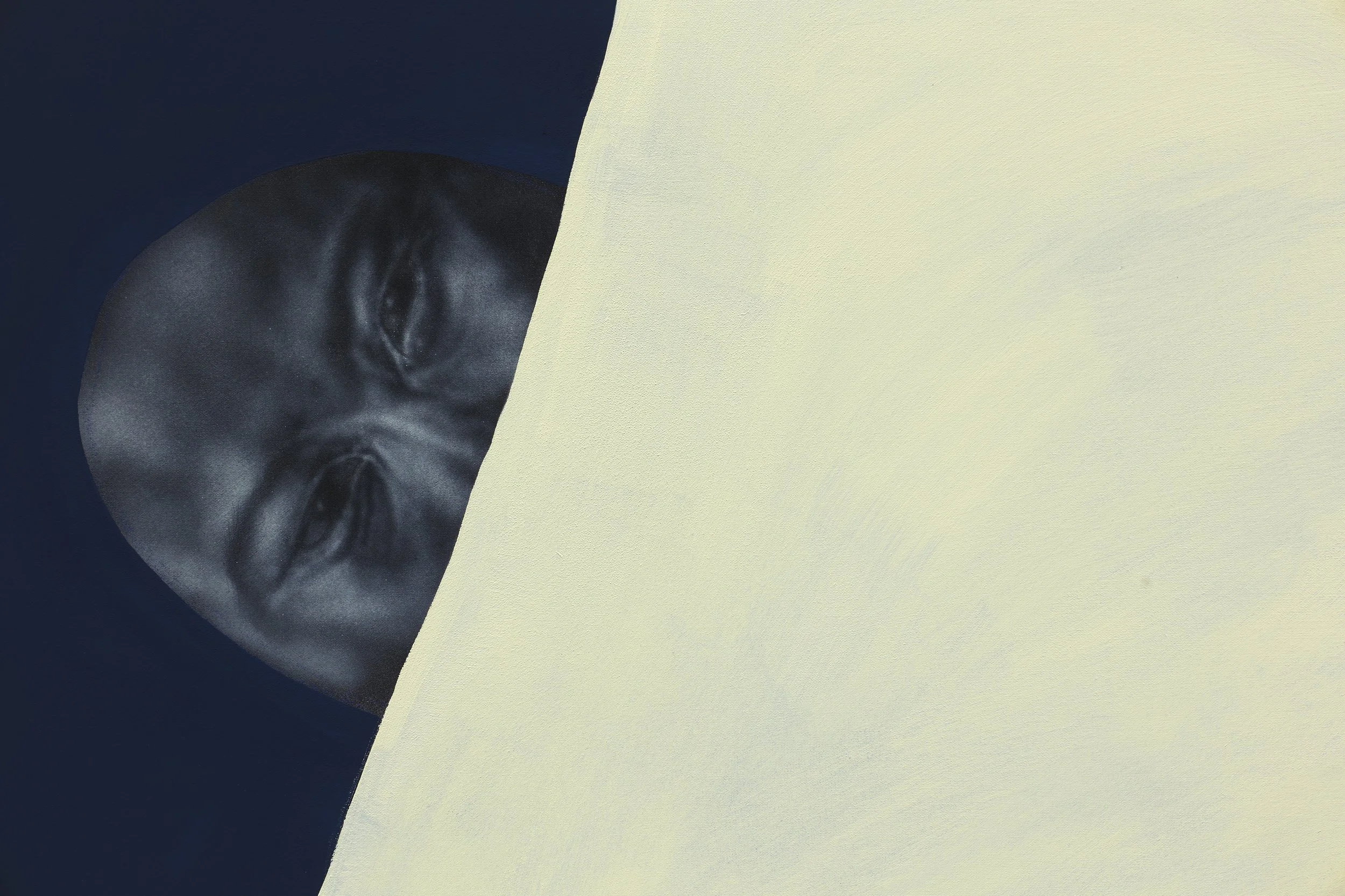
(un)learning friction
24 November - 29 December 2026 · London
FEATURED ARTISTS: Dora Lam, Filippo Muzi Falconi, Betty C Fan, Myriame Dachraoui, Leyla Borovalı
The authority of images shapes how memory, myth and knowledge take form, while friction opens space for ideas that resist singular readings. As a methodology, (un)learning friction traces where authority gathers, shifts, frays and changes hands.
The exhibition examines how power operates through three interrelated registers: seeing, knowing and interpreting. Spanning painting, sculpture, sound and ceramics, the works position both medium and domestic space as autonomous agents where scale, tactile proximity and spatial residue construct the discourse. Reduction-fired clay registers the conditions across its surface, while a sculptural instrument staged as an artefact holds preservation in tension with impermanence. Through archival fragments, inherited habits and behaviours inform pictorial structure; within Tunisian folklore, shifting form unsettles the boundary between the familiar and the monstrous; and in found stones, imagined stages of emergence give way to new forms.
(un)learning friction inhabits the moment before meaning hardens. Suspended at the threshold of recognition, the friction generated between these mediums opens the work to continuous re/encountering.
Text by Senem Cagla Bilgin-Keys
BIOGRAPHIES
Myriame Dachraoui is a Tunisian architect and painter based between Tunis and London. Her practice explores the anxieties surrounding the female gaze, the body, intimacy, and surveillance within private and public spaces. Drawing from family photographs, Tunisian myths, and local symbols, she constructs scenes that examine relationships between looking, memory, and control. Informed by her architectural background, her paintings challenge conventional perspectives. Since 2023, she has exhibited internationally, with works held in notable private collections.
Leyla Borovalı is a Turkish ceramicist based in London. Holding degrees from Parsons School of Design and the Royal College of Art, her practice explores materiality, form, and memory through ceramics and textile traditions. Drawing inspiration from İzmir and the Mediterranean, she translates motifs from silk quilts, kilims, embroidery, and lacework into layered sculptural surfaces. Her work reflects on personal narratives, cultural heritage, and resilience, exploring how traditional patterns and their histories can be preserved and reinterpreted through clay.
Filippo Muzi Falconi is an Italian artist based in London, working primarily in sculpture. With a background in social psychology and woodworking, his practice explores materiality, ecology, and humanity’s relationship with nature. Working with foraged materials such as wood, wild clay, and natural pigments, he creates sculptures rooted in their landscapes. Drawing on biology, archaic narratives, and traditional processes, his work challenges human-centred perspectives and globalised production systems, seeking to establish a more spiritual and reciprocal relationship with the natural world.
Dora Lam is a London-based artist and Royal College of Art graduate, where she received the Cass Art Scholarship. A QEST Scholar, she has also been shortlisted for the Chadwell Award. Her practice explores the complexities of looking, drawing on colonial and personal archives to examine how images are constructed and interpreted. Combining meticulous rendering, bold colour, and unstable perspectives, her paintings challenge familiar visual narratives and conventional forms of representation. Her work has been exhibited at the ICA, Bristol Museum & Art Gallery, and Museum of the Home.
Betty C Fan is a London-based artist born in Taipei and raised in Hong Kong. With a background in music and architecture, her practice spans sculpture, sound, poetry, and performance. Through handmade instruments, written works, and sonic interventions, she explores the structures that shape human experience and their gradual transformation. Drawing on natural sounds and materials, Fan examines the tensions between permanence and erosion, structure and change, questioning how the systems and habits that sustain us can also become forms of confinement.